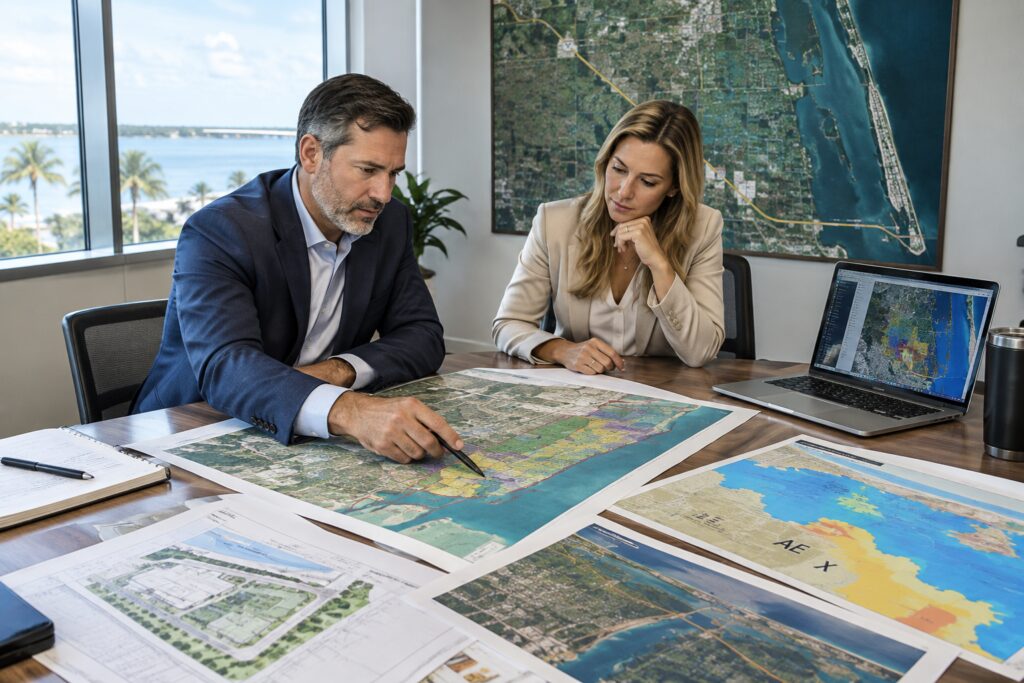
The most important land-use story in Vero Beach right now is not the glossy riverfront renderings; it is the way small parcels near Route 60 and 58th Avenue may be revalued as utility reach, traffic concurrency, and height/density rules start to move in the same direction. Buyers watching Three Corners, the Indian River Lagoon corridor, and the barrier island in 32963 should pay close attention to the mainland because the next pricing swing may come from what can be built, not just what can be seen.
How the Three Corners buildout changes mainland value assumptions
Three Corners is more than a waterfront amenity project. Its implementation affects how owners, investors, and lenders think about nearby commercial land, especially parcels that depend on access, parking, and stormwater capacity rather than pure frontage. As site plans advance and supporting infrastructure is phased in, the market starts to separate parcels that are simply in the path of growth from parcels that can actually absorb new use without a costly entitlement fight. For buyers, Zoning Laws are no longer an abstract planning issue; they are the gatekeeper for whether a site can support more intense use, a better lease-up profile, or a stronger resale story.
That matters on the mainland because the buyers who win in Indian River County usually underwrite the whole corridor, not just the lot. A property near Route 60 may look functionally similar to another nearby parcel, but one may already have utility capacity, acceptable turn movements, and a cleaner path through site plan review while the other is still constrained by ingress, drainage, or land-use intensity. In practice, that difference can alter asking price, time to closing, and the leverage a buyer has when negotiating contingencies. It also affects how local brokers compare the site to downtown, to the riverfront, and to the commercial pockets that serve the east side of the county.
Live Local Act approvals, AE vs. X, and the barrier island code ripple effect
On the barrier island, the conversation changes quickly. Live Local Act mixed-use approvals can create a path to greater height or density on paper, but the physical constraints of the Atlantic coastal barrier island still matter: flood elevations, parking ratios, evacuation access, and the barrier island commercial parkway code all shape what is actually financeable. The same is true for Flood Zones. A property in AE may be perfectly usable, but it typically demands a more careful capital stack, more documentation, and a sharper insurance strategy than an X-zone site. In 32963, those distinctions are not academic. They can determine whether a project stays viable after lender review, carrier review, and the first round of construction pricing.
Indian River County buyers also need to watch how code updates affect the secondary uses that make a parcel productive. Along the island corridors, commercial owners often depend on signage, limited parking fields, delivery access, and building massing that fit a coastal roadway. If a code amendment tightens frontage standards or changes how a mixed-use building transitions from retail to upper-story residential, that can change the expected income stream. Mainland buyers should not assume those rules stop at the waterline. The broader market absorbs those changes through rent expectations, comparable sales, and the willingness of tenants to sign long-term leases in buildings that must meet new milestone, structural, or access requirements.
4-point zoning and land-use due-diligence checklist
- Confirm the current land use, zoning district, and any pending amendments. A parcel’s value changes fast when a county or city is considering a comprehensive plan amendment, a rezoning, or a special exception that could increase intensity or limit it.
- Verify flood status, elevation, and insurance exposure. Compare AE and X zones, ask for the latest survey or elevation certificate, and confirm whether the site’s grading, stormwater, and finished floor assumptions match lender expectations.
- Review access, concurrency, and utility availability. Water, sewer, driveway permits, turn lanes, and traffic concurrency can be the difference between a workable project and a stalled one, especially on growth corridors like Route 60 and 58th Avenue.
- Check HOA, condo, and milestone obligations before you commit. Shared ownership structures can add reserve assessments, inspection costs, or repair obligations that affect cash flow, exit timing, and financing even when the underlying zoning looks favorable.
Final Considerations for Vero Beach Buyers
Vero Beach buyers who focus only on headline projects miss the real underwriting risk: entitlement timing, flood exposure, and the local code environment that decides whether a site can be scaled, financed, insured, and resold without surprises. A well-located parcel near the Indian River Lagoon or the mainland service corridors may still be the right buy, but the smartest purchase is the one that has been tested against Indian River County regulations, utility capacity, access rules, and the practical realities of the barrier island and mainland market split. That is especially true when Three Corners, Live Local density approvals, and zoning updates are all moving at once.
FAQ
How do urban service boundary adjustments along Route 60 affect a property’s value?
When a parcel falls inside or closer to an urban service boundary, it may have better access to water, sewer, and higher-intensity uses, which can improve marketability and financing. The value lift is strongest when zoning, access, and concurrency also align; a boundary change alone does not guarantee approval.
What should buyers check first on barrier island commercial properties in 32963?
Start with flood zone classification, elevation, parking supply, access to A1A, and any condo or HOA obligations tied to the property. Then confirm whether the site can satisfy current code requirements, insurance standards, and any milestone-related repair or reserve expectations.
For tailored guidance and experienced local representation, connect with MacEvoy Real Estate Co. to protect your coastal investment.